The Concept of Total ArchitectureSM
The Enterprise IS the System
An enterprise comprises people, business processes, information, and systems collaborating to provide business value. This is the Total Architecture perspective.
Significant business problems arise when this collaboration does not work well. Determining the collaboration required to better deliver business value is an essential precursor to the design, selection, and integration of information systems. Designing a system without first designing the solution surrounding the system runs a 50% risk of delivering inadequate functionality with cost and schedule overruns, and a 30% risk of initiative cancellation.
Total ArchitectureSM Business Initiative Methodology mitigates these risks, guiding enterprises through the solution design and ensuing systems designs. Not only does the methodology mitigate the risks, it yields a 25% reduction in the duration of the initiative.
This Executive Overview provides a brief, high-level overview of the Total Architecture Methodology.
Total ArchitectureSM is not a choice. It is a concession to reality.
Total ArchitectureSM Business Initiative Methodology Stages
The Total ArchitectureSM methodology creates an enterprise digital twin (EDT) of the enterprise in both as-is and to-be configurations. The approach leverages scenario-based business process analysis to break down silos and proceed rapidly from business purpose to executable solutions while mitigating risks. It exposes friction points where handoffs fail and data can be lost.
The approach is applicable to ongoing initiatives as well, reducing risk while aiding the planning of the overall enterprise architecture. And beyond crafting the new solution, the EDT provides the context for quickly determining the impact of market disruptions on the enterprise.
Total Architecture uses the techniques of model-based system engineering (MBSE) and the Unified Architecture Framework (UAF) to craft the EDT. This comprehensive approach precisely captures all relevant information from enterprise goals and objectives through solution design and on to intended deployments. It provides the context for determining the scope of proposed changes and evaluating various design alternatives.
These methodology stages are enforced through objective governance gates and executive dashboard tracking.
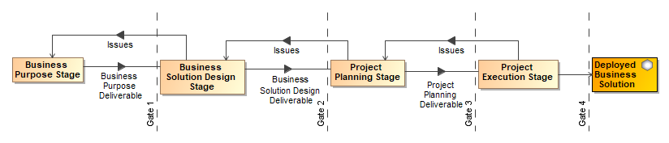
Business Purpose Stage
While business goals provide a good starting point for an initiative, to be effective they must be translated into measurable objectives that reflect an understanding of the drivers for change, the the challenges to be faced, and the perceived opportunities for improvement. Formulating a well-defined business case for the initiative provides a solid foundation for exploring potential business solutions.
Business Solution Design Stage
The business solution design stage answers the “How is this going to work?” question in a way that can be understood both by both the executives and the folks in the trenches. You don’t want this to be a mystery to be revealed when the solution finally goes live. You want to know this right up front before you make the investment. All personnel are involved in sanity checking and evolving the approach until all are satisfied that the proposed solution can actually achieve the measurable objectives. The goal is consensus.
The stage begins by understanding the current solution. It is risky to try and change something you do not understand, and the reality is that nobody thoroughly understands how your enterprise actually works. Acquiring this understanding has two benefits. One is that it very specifically highlights the pain points in the current approach. The other, equally important benefit is that it identifies all the activities performed and the information and work products currently involved in the process. Since these generally re-appear in some form in the enhanced solution, this inventory serves both as a starting point and as a completeness check for the new design.
The new solution design provides a high-level understanding of how the core business functions will work: who (people and systems) does what and when, what information is required, and how work products are produced and handled. Frequently there will be an exploration of alternative designs. The plausibility of each design is evaluated in terms of its ability to achieve measurable business objectives. The winning design is selected for implementation.
Project Planning Stage
Organizing the Work
Once a solution design has been selected, the next task is to organize the work required to put the solution into production and ensure business objectives have been achieved.
This is more to it than just chartering a single IT project for that big system. Projects are needed to integrate with other systems and perhaps modify those systems. There may be work required to update policies and procedures and train staff. And finally, the activities required to operationally transition from the current solution to the new solution need to be organized.
These projects have dependencies on one another. These dependencies will determine the sequence in which the projects need to be executed. The execution of the projects must be carefully and coordinated to ensure a low-risk deployment.
Specifying Requirements
Once the work has been identified and organized into projects, the requirements for each project must be specified. The solution design provides the majority of the requirements for each project, but there may be policy and legislative constraints that need to be incorporated as well.
Project Responsibility
The final task of the planning stage is to determine who will be responsible for each of the projects and ensure those parties have the skills required to execute each project. Which ones will be handled in house? Which will be contracted out? What approach will be taken to identify and engage suitable contractors?
The validated solution design and derived project requirements provide precise technical substance for proposal requests and ensure a good fit between the contract deliverables and the solution they are intended to support.
Project Execution Stage
Once the projects have been defined and the responsible parties have been identified, it is time to begin project execution. Many tombs have been written about project management and its best practices. The Total Architecture methodology has nothing to add to these other than to recommend that industry best practices be followed.
The History of Total Architecture
Total Architecture has been in active field use for more than 25 years. It began with the realization that it takes many systems to run an enterprise, and that these systems do not live in isolation: they interact with one another and with the people in the enterprise. The business processes are a collaboration between people and systems. The enterprise itself is a complex system of systems and people, known in technical terms as a distributed system.
Evolution
Over the years, field experience has led to a subtle shift in emphasis. Early work covered all aspects of distributed systems, including fault tolerance, high availability, scalability, and security.
In practice, it became apparent that the most expensive design errors were in the high-level structure and organization of the business processes and systems – the solution design. It was found that an examination of the proposed behavior, i.e. the collaboration between people and systems, exposed these design flaws early in the game, allowing the flaws to be corrected before any significant investment had been made.
Another emerging realization was that it is important to model at different levels of abstraction and present targeted views of the model to different stakeholders, from C-level down to knowledge workers and coders, in terms they can readily understand. Recently an ad-hoc structuring of these levels has been replaced with the rich structures of the Unified Architecture Framework (UAF).
Courses and Certification
Several professional courses were developed based on Total Architecture. These courses, each corresponding to one of the TIBCO books below, used the Total Architecture approach to explore the architectural concepts related to the topic and then explain the role that specific TIBCO products could play in a distributed systems architecture.
A certification program was also developed for TIBCO Architecture Fundamentals. This week-long hands-on exercise provided the candidate with the opportunity to demonstrate both architectural skills and product-specific knowledge. A panel of subject-matter experts graded each exercise and determined the candidate’s qualification for certification.
Publications
The earliest books on Total Architecture focused on a particular type of distributed system architecture known as a service-oriented architecture (SOA). Despite the use of the SOA terminology, the focus of the books is the Total Architecture of the enterprise.
The first two books are technology agnostic and cover the principles of Total Architecture from both a business and technical perspective. The remaining three books use Total Architecture to explain the usage of specific TIBCO technologies. Each first explores its topic from the Total Architecture perspective and then dives into the specifics of employing the relevant TIBCO products.
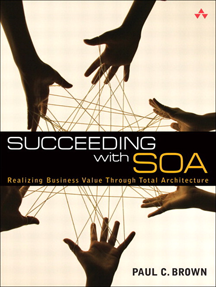
Succeeding with SOA: Realizing Business Value Through Total Architecture
This book describes total architecture from the business, management, and organizational perspective. The intended audience includes business and IT managers as well as project and enterprise architects.
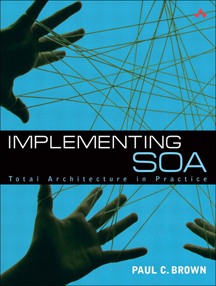
Implementing SOA: Total Architecture in Practice
This book is a working guide for the practicing architect implementing total architecture. The intended audience includes both project and enterprise architects.
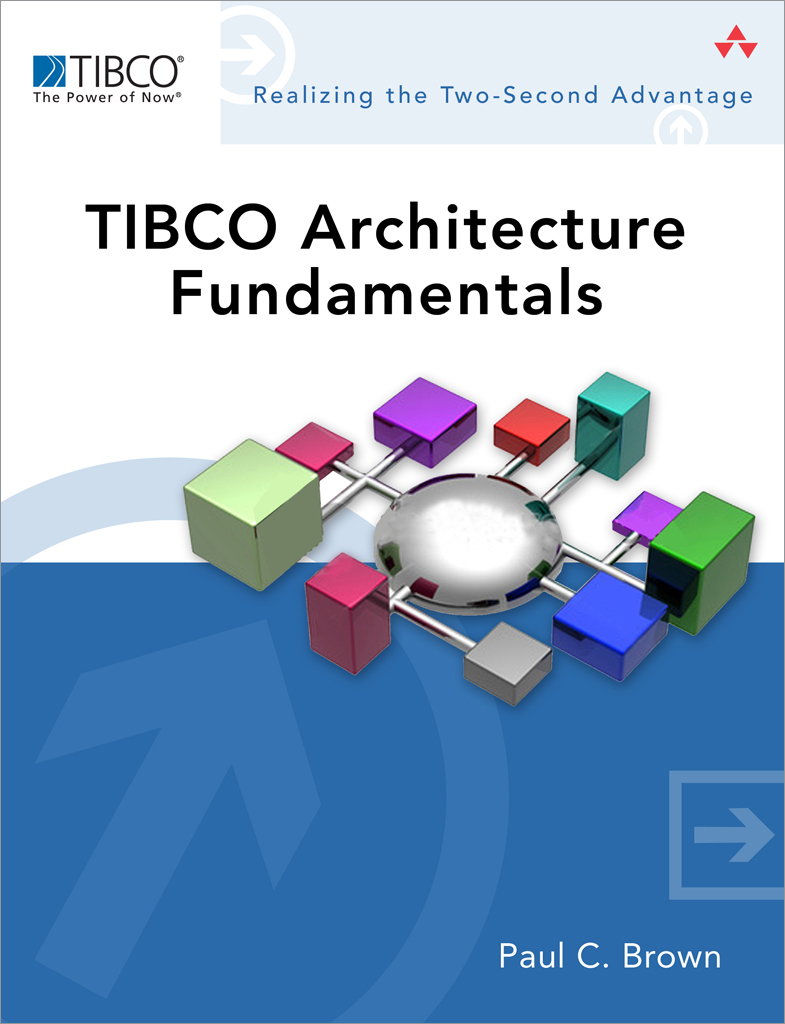
TIBCO Architecture Fundamentals
This is the core book for understanding and using the TIBCO product suite. The book provides a sound basis for applying TIBCO products to solve the most common integration and SOA challenges faced by architects and developers. It lays the foundation for the more advanced books in the TIBCO architecture series.
Architecting Composite Applications and Services with TIBCO
There are many possible architectures for composite applications and services. Some will serve the enterprise well, while others will lead to dead-end projects. This book shows how to create successful architectures for both overall solutions and individual services.
Architecting Complex-Event Processing Solutions with TIBCO
Complex-event processing is required when multiple events must be sensed, analyzed, prioritized, and acted on in real time. This book shows how to design and architect these systems, addressing all their complexities while delivering business value.